Fasting and Eating for Health: A Medical Doctor's Program for Conquering Disease by Joel Fuhrman Barnard & Neal D
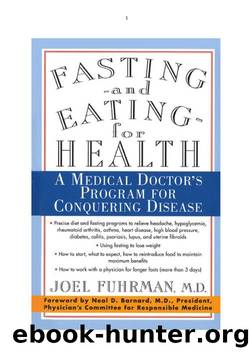
Author:Joel Fuhrman Barnard & Neal D. [Barnard, Joel Fuhrman]
Language: eng
Format: epub
Chapter 6
Recovery from Diabetes Through Optimal
Nutrition
One in 20 people has diabetes in this country. Diabetes, our seventh leading cause of death, is also a nutritionally related disease, one that is both preventable and reversible through nutritional methods. Like many other chronic diseases, diabetes is increasing in prevalence in the United States.
There are basically two types of diabetes: type I, or childhood-onset diabetes, and type II, or adult-onset diabetes. In type I, which generally occurs earlier in life, children incur damage to the pancreas, the organ that produces and secretes insulin, so they have an insulin deficiency. In type II, the individual still produces near-normal levels of insulin, but the body is resistant to it, so the level of blood sugar, or glucose, rises. The end result is the same in both types of the disease: the individual has a high glucose level in the blood.
Both types of diabetes accelerate the aging of our bodies. Having diabetes greatly speeds up the development of atherosclerosis, or cardiovascular disease. Diabetes also ages and destroys the kidney and other body systems.
Forty thousand amputations per year are due to complications of diabetes. It is the leading cause of blindness in adults and of kidney failure.
Diabetics, regardless of the type, have abnormal blood lipids, meaning they have higher levels of triglycerides and lower levels of HDL (the "good"
cholesterol) in their blood than the general population. The overproduction of triglycerides in particular is probably related to the increased flux of glucose and fatty acid substrates to the liver.1 Unfortunately, at any given cholesterol or triglyceride level, diabetics have a much higher risk of coronary heart disease, compared to the nondiabetic population.
In both types of diabetes, the high glucose level in the blood damages the body. In conjunction with blood lipids, it inevitably causes a significant acceleration of the atherosclerotic process, hardening and narrowing the blood vessels: Atherosclerosis accounts for 80 percent of all diabetic deaths. Diabetics have more than four times as many heart attacks as nondiabetics. One third of all patients with insulin-dependent diabetes die of heart attacks before age 50.2
Diabetics should be made aware that they can protect themselves from becoming part of these morbid statistics. But diabetics are typically given the wrong recommendation by the professionals caring for them. You would expect that any dietary recommendations designed for diabetics would attempt to reduce the risk of a heart attack, stroke, or other cardiovascular event.
Unfortunately, this is not the case. In fact, the typical dietary recommendations suggested to diabetics by their doctors and dieticians have been shown to allow the advancement of athersclerosis in normal patients, let alone diabetics.3,4
99
Both interventional studies and large epidemiologic (population-based) studies have shown conclusively that certain diets promote cardiovascular disease and diabetes, and that other nutritional practices can prevent and reverse them.
The Lifestyle Heart Trial is just one of several studies that document that the standard recommendations (utilizing a diet in which 30 percent of calories come from fat) allow the progression of heart disease even in nondiabetic patients. These
Download
This site does not store any files on its server. We only index and link to content provided by other sites. Please contact the content providers to delete copyright contents if any and email us, we'll remove relevant links or contents immediately.
Personalized inhaled bacteriophage therapy for treatment of multidrug-resistant Pseudomonas aeruginosa in cystic fibrosis by unknow(175283)
CONSORT 2025 statement: updated guideline for reporting randomized trials by unknow(83682)
Critical evaluation of the ProfiLER-02 study design and outcomes by Vivek Subbiah & Razelle Kurzrock(83362)
Cardiac gene therapy makes a comeback by Oliver J. Müller & Susanne Hille & Anca Kliesow Remes(83222)
Whisky: Malt Whiskies of Scotland (Collins Little Books) by dominic roskrow(74436)
Unveiling the design rules for tunable emission in graphene quantum dots: A high-throughput TDDFT and machine learning perspective by Şener Özönder & Mustafa Coşkun Özdemir & Caner Ünlü(50892)
A yeast-based oral therapeutic delivers immune checkpoint inhibitors to reduce intestinal tumor burden by unknow(40259)
Covalent hitchhikers guide proteins to the nucleus by Alexander F. Russell & Madeline F. Currie & Champak Chatterjee(40215)
Meet the Authors: Christopher R. Mansfield and Emily R. Derbyshire by Christopher R. Mansfield & Emily R. Derbyshire(40094)
Alkaline-earth metals promote propane dehydrogenation with carbon dioxide through geometric effects: Altering the reaction pathway by unknow(32730)
Induced iron vacancies boosting FeOOH loaded on sustainable Fenton-like collagen fiber membrane for efficient removal of emerging contaminants by unknow(32504)
Efficient electric-field-assisted photochemical conversion of methane to n-propanol exclusively over penetrated TiO2Ti hollow fibers by Guanghui Feng(32452)
Bi2SiO5 nanosheets as piezo-photocatalyst for efficient degradation of 2,4-Dichlorophenol by Hangyu Shi & Yifu Li & Lishan Zhang & Guoguan Liu & Qian Zhang & Xuan Ru & Shan Zhong(32384)
A novel NDIPTA organic heterojunction photocatalyst with built-in electric field for efficient hydrogen production by Jiahui Yang & Baojun Ma & Yongfa Zhu(32360)
Enhanced conversion of methane to liquid-phase oxygenates via hollow ferrite nanotube@horseradish peroxidase based photoenzymatic catalysis by Jun Duan & Shiying Fan & Xinyong Li & Shaomin Liu(32331)
Ordered macroporous superstructure of defective carbon adorned with tiny cobalt sulfide for selective electrocatalytic hydrogenation of cinnamaldehyde by Xiao-Shi Yuan & Sheng-Hua Zhou & San-Mei Wang & Wenbo Wei & Xiaofang Li & Xin-Tao Wu & Qi-Long Zhu(32256)
What's Done in Darkness by Kayla Perrin(27145)
Topological analysis of non-conjugated ethylene oxide cored dendrimers decorated with tetraphenylethylene: Insights from degree-based descriptors using the polynomial approach by A Theertha Nair & D Antony Xavier & Annmaria Baby & S Akhila(26522)
Investigation of mechanical and self-healing properties of hydroxyl-terminated polybutadiene functionalized with 2-ureido-4-pyrimidinone by Mohsen Kazazi & Mehran Hayaty & Ali Mousaviazar(26457)
